

Industrial Positioners vs. Cranes: What’s Best for Moving Heavy Weldments
When it comes to moving heavy weldments or components, safety is always a top priority on your floor. Manufacturers are faced with a massive challenge when it 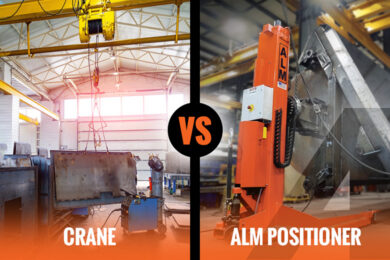 comes to moving parts that are thousands of pounds. Transporting large workpieces is usually a unique process, with every manufacturer having their own method depending on available equipment and manufacturing environment.
We’re providing a closer look at when to utilize a crane or a positioner when moving heavy weldments to improve workflows, safety and productivity.
Transporting the workpiece: starting with cranes
Whether your floor works in welding or assembly, the first step is getting components to the right place so that work can begin. This step often involves cranes. Moving heavy weldments requires strong attention to detail and safety, and cranes are usually utilized during this process. They are essential for loading fixtures, moving assemblies and handling parts that are too heavy for forklifts.
However, once a load is suspended with the crane using chains, it can swing, shift or require extra rigging and personnel to control. While cranes can lift and transport weldments or large components, it is not usually the best device for holding that weldment at a controlled weld angle for extended periods.
That’s when a positioner comes into play.
Strength and precision: when to use a positioner for welding
Intelligent industrial positioners are the best choice once a weldment or workpiece has arrived at the bay or weld cell. That’s because positioners have a wide range of capabilities and are designed to provide precise, controlled access for welders and assemblers. That provides a much safer and more efficient option over cranes.
Positioners are especially useful when a weldment must be rotated or tilted many times during fabrication. Rather than stopping work to re-rig the part, the operator can adjust the workpiece with a click of a button. There are even hands-free options that allow them to move the piece through voice commands.
Why use a welding positioner?
- Enhanced safety: By eliminating overhead chains, cranes or climbing ladders, your workpiece is in rock-solid place while working on it. This will give your welders confidence and peace of mind. It also eliminates time-consuming manual pushing, pulling or prying.
- Improved access: Welders and assemblers can work more comfortably and can produce higher-quality welds by bringing the workpiece to them.
- Precise and repeatable: Many manufacturers are working on the same size of part over and over. Positioners allow precise configuration to get the part exactly where you need it every time. With ALM’s Precision Line, you can even gain positioning speeds 5-10 times faster than competitive alternatives, helping reduce cycle time and accelerate production.
Choosing the right tool for the job
It’s likely that both cranes and industrial positioners have a place on your manufacturing floor. The key is making the transition from a crane to a positioner at the right time in order to create a better, faster and safer work process.
Cranes are the best tool to help transport the workpiece to its place, and then a positioner can lock in and hold the piece reliably with strength and accuracy so that it can be worked on comfortably. This provides your team the best working environment possible and has proven to boost production throughput by as much as 40 percent.
Need help determining the right industrial positioner for your workflow? With a full lineup of welding positioners, the expert team at ALM is ready to configure and build the perfect solution for your needs.
Ready to utilize an industrial positioner for welding? Contact us or call our team at 309.787.6200.
See all our news and testimonials.