

How Welding Positioners Help Manufacturers Meet Data Center and Energy Demand
Across North America, one sector is clearly booming: data and energy. With nearly 5,000 data centers currently operating or under construction in the US (US Data 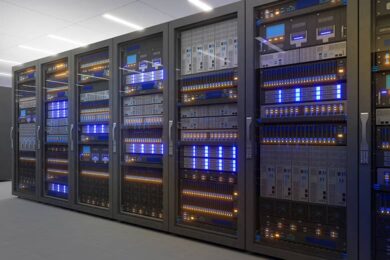 Center Map), subcontractors are rushing to manufacture the components these centers need to operate, including large skids, frames, tanks, generators, racks and more. There’s one thing all these components have in common: they’re welded together.
With skyrocketing demand and a shortage of skilled laborers, many energy and data contract manufacturers are turning to ALM Positioners to help bridge the gap. With the introduction of an intelligent positioner to their large-scale welding and assembly operations, customers are seeing throughput increases by over 40 percent.
Data centers are going up faster than the energy grid that powers them can expand, and contract manufacturers are being asked to produce very high volumes of very large weldments. Demand is a good problem to have, but it’s a problem, nonetheless.
“We have manufacturers coming to us who have a contract to build, say, 200 of these large tanks for data or energy sector use over the coming months,” Kevin Toft, Chief Revenue Officer at ALM Positioners, said. “The rapid infrastructure growth is forcing fabricators to find ways to increase their speed, and a robot-ready positioner is one of the most effective ways to do that while also maximizing safety on the floor.”
How welding positioners support data center and energy equipment manufacturing
- Increase throughput on large, repeatable weldments. Contract manufacturers serving the data center and energy sectors are being asked to produce more large-scale components in less time. A positioner lifts and rotates the weldment so operators can keep working instead of stopping production to reposition it with a crane.
- Allow for robot-ready efficiency. ALM can work with your integrator to engineer the right level of automation for your positioner, from semi-automated welding with a cobot to fully automated straight linear welds. Because many data center and energy components are highly repeatable, they’re well suited to automation, and a robot or cobot working with a positioner can weld significantly faster than manual methods.
- Make large-scale welding and assembly safer. Data and energy manufacturers are manipulating massive weldments, which makes the work riskier. A positioner reduces the need to hoist and reposition large parts with a crane, making the floor safer for everyone.
See how ALM Positioners’ headstock and tailstock positioner allowed for robot-ready production capability for an autonomous welding cell for a generator tank. This application features a dual arm cell weld on a large tank. The positioners were configured for parts up to 55,000 lbs, and 60 feet long and autonomously rotate the workpiece.
Video credit: Path Robotics